
ADHD - The Trend
When awareness becomes content, who gets to decide what is helpful and what is harmful?
Chapter 01The 1am diagnosis pipeline
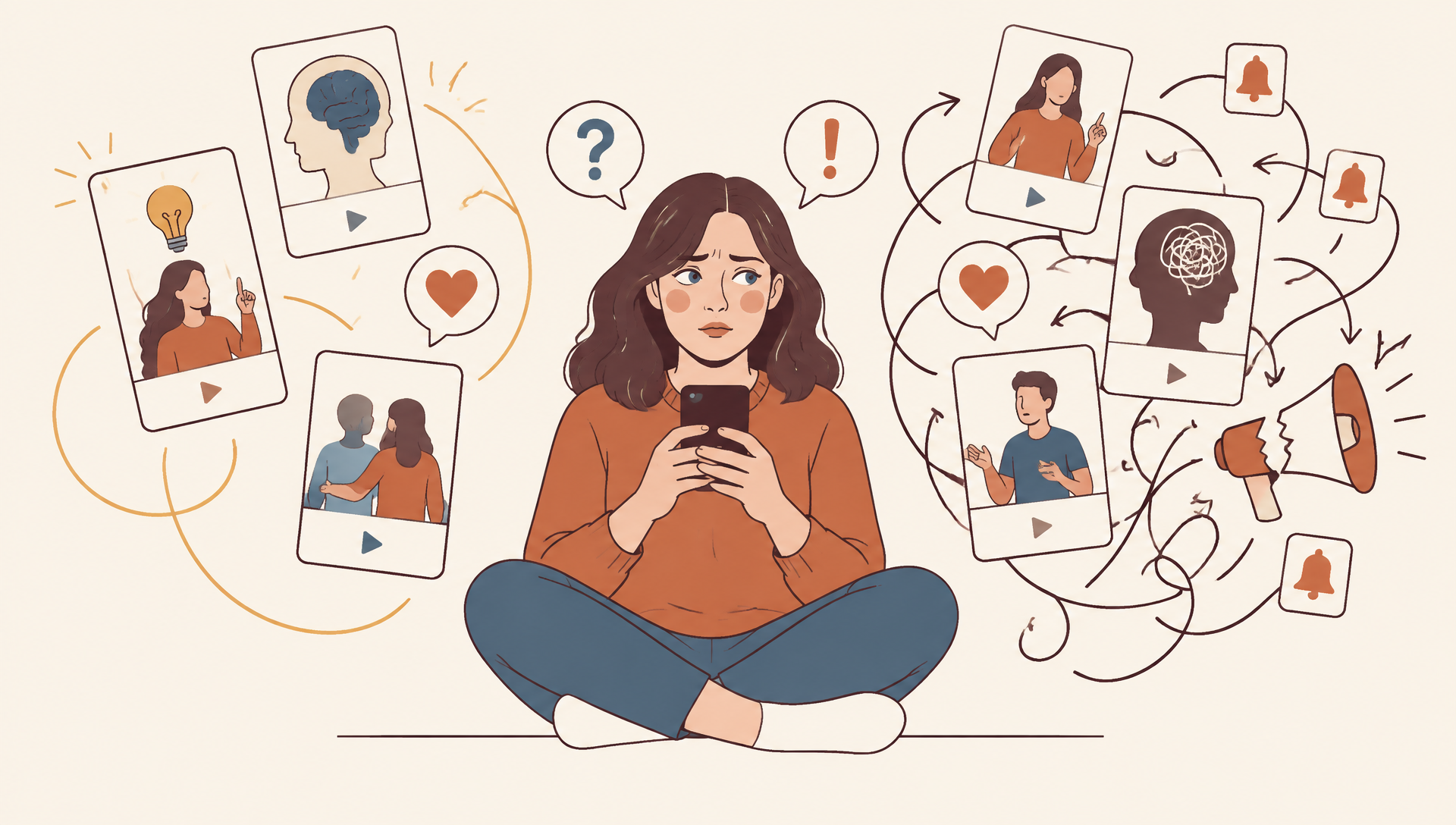
It's 1am. You're in bed, even though you should've been asleep two hours ago, and a woman on TikTok is listing "five signs you've got ADHD that nobody talks about". One sounds familiar. Then another. By the fifth, TikTok has apparently diagnosed you and the comments are full of people asking, "Wait, this isn't normal?"
By breakfast, you've watched videos about emotional dysregulation, time blindness, rejection sensitivity, masking and ten other things that suddenly sound very familiar. Your feed changes almost overnight. Watch one ADHD video and TikTok decides you need another fifty before you've even got out of bed. Nothing says responsible healthcare quite like being assessed by an app that also shows you strangers pressure-washing their driveways.
I get why people are drawn in. If you've spent years blaming yourself for things you couldn't seem to control, hearing somebody else describe them can hit hard. But there's an uncomfortable question underneath all of this: what happens when a medical condition has to perform for an algorithm?
Chapter 02The bit TikTok got right
Before we burn the whole app at the stake, TikTok has done something genuinely useful. It's given people the words to explain things they've struggled with for years. Masking, executive dysfunction and sensory overload are now part of normal conversations. For women especially, it showed a version of ADHD that wasn't just a little boy bouncing off a classroom wall while an exhausted teacher quietly reconsidered every decision that led her to that career.
The NHS acknowledges that ADHD is recognised less often in women because inattentive symptoms can be harder to spot. Research into women diagnosed as adults describes years of emotional difficulty and feeling out of control before diagnosis. So no, recognising yourself in somebody else's story isn't automatically silly or attention-seeking. Not when you've spent decades thinking you're lazy, dramatic or just absolutely shit at being an adult.
A sixty-second video can't diagnose you. It can, however, make you stop and ask questions. It can send you looking for proper information or give you the push to speak to your GP. For plenty of late-diagnosed women, the first useful clue didn't come from school, work or a doctor's surgery. It came from another woman being honest online.
Chapter 03When relatable becomes diagnostic
This is where it gets messy. Relatable and diagnostic aren't the same thing. Everyone forgets why they walked into a room sometimes. Everyone puts things off. Everyone gets distracted by their phone, especially when every app on it has been designed to keep them staring at it.
ADHD isn't one habit that makes a funny video. Clinicians look for a persistent pattern of symptoms going back to childhood, showing up in more than one part of your life and actually affecting your ability to function. Your history matters. The severity matters. The wider context matters. TikTok strips most of that away because nuance doesn't get views. Apparently, a lifelong neurodevelopmental condition is much easier to explain when you've got sixty seconds, a ring light and absolutely no medical qualifications.
In a widely cited review of the 100 most popular ADHD TikToks, clinicians rated 52 per cent as misleading. Only 21 per cent were considered useful. That doesn't mean every creator was deliberately lying. Some treated ordinary human behaviour as an ADHD symptom. Others made huge claims with no context or gave advice without mentioning the risks. Somebody can be completely honest about their life. It becomes a problem when their personal experience is presented as a diagnostic checklist for everybody else.
If everything is an ADHD symptom, ADHD stops meaning anything at all.
Chapter 04Confidently wrong
What worries me isn't simply that inaccurate videos exist. The internet has always been full of confident nonsense. It's what happens when you see the same nonsense over and over again.
A 2025 experiment involving 490 students found that people shown inaccurate ADHD TikToks came away with less accurate knowledge but more confidence in what they thought they knew. That's the really worrying bit. They weren't just wrong. They became more certain that they were right.
Algorithms don't reward careful explanations. They reward the video that makes you stop, recognise yourself and send it to three friends. "This can happen with ADHD, but it also overlaps with other conditions and needs a proper assessment" is accurate. "If you sleep like this, you've got ADHD" gets views. One is medically responsible. The other comes with dramatic pointing and a trending sound, so obviously we know which one wins.
Then the backlash starts. People see a ridiculous video and decide ADHD itself must be ridiculous. They mock the terminology, dismiss every newly diagnosed adult and use bad content as proof that the whole condition has been invented by the internet. We end up squeezed between two equally insulting versions of ourselves: a cute online personality or a gullible adult who copied a diagnosis from TikTok. Neither comes close to the reality of living with it.
Chapter 05The system left the door open
It's easy to blame TikTok for the rise in people asking about ADHD. It's harder to admit why they're asking an app in the first place. UK services are overwhelmed. People are waiting years for assessments. Some areas have tightened access or closed waiting lists altogether. When proper help feels impossible to reach, people turn to whatever's available at 1am. In Britain, this is apparently what passes for a care pathway now.
That doesn't make every self-diagnosis correct, and it doesn't make every creator an expert. It means this trend didn't appear from nowhere. Social media made ADHD more visible at exactly the point the health system couldn't cope with everybody asking for help.
Recorded diagnosis has risen, but that isn't evidence that ADHD has suddenly been invented. The Royal College of Psychiatrists says the condition remains under-recognised, under-diagnosed and under-treated. Both things can be true at once: bad information can spread quickly, and people with real ADHD can still be waiting far too long for help.
Chapter 06A starting point, not a verdict
I don't want anybody who first recognised their symptoms through TikTok to feel embarrassed. I've recognised parts of myself online too. There's nothing wrong with seeing your own experience in somebody else's. Just don't let an algorithm decide what that experience means for you.
If a video hits home, use it as a reason to look further. Think about how long it's been happening and where it actually affects your life. Read information from the NHS and established ADHD organisations. Speak to a qualified professional when you can. Follow creators who separate personal experience from medical fact, show their sources and are willing to say, "I don't know."
If you make ADHD content, you've got a responsibility too. Your story can make somebody feel less alone without becoming a checklist. You can be funny without turning disability into an aesthetic. You can say, "This is what ADHD feels like for me," without saying, "If you do this too, you've got it."
ADHD is having a cultural moment. Hopefully some good comes from it: better recognition, more research and actual support. Some of the content will age horribly, because the internet always moves on to something else. But when it does, we'll still be here. We'll still be dealing with medication, work, money, relationships and burnout long after the hashtag stops trending. The algorithm may get bored of ADHD. Unfortunately, our ADHD hasn't agreed to do the same.
Sources and further reading
- The Canadian Journal of Psychiatry study reviewing the 100 most popular ADHD TikToks.
- European Child & Adolescent Psychiatry experiment on ADHD misinformation, knowledge and confidence.
- NHS guidance on ADHD in adults, including why it is recognised less often in women.
- Miss. Diagnosis, a systematic review of ADHD in adult women.
- Royal College of Psychiatrists statement on ADHD being under-recognised and under-treated.