
I'd Only Just Started Unmasking. Now I Feel Like I Have to Hide Again.
The strange fallout of finally showing up as yourself in a world that's decided your diagnosis is up for debate.
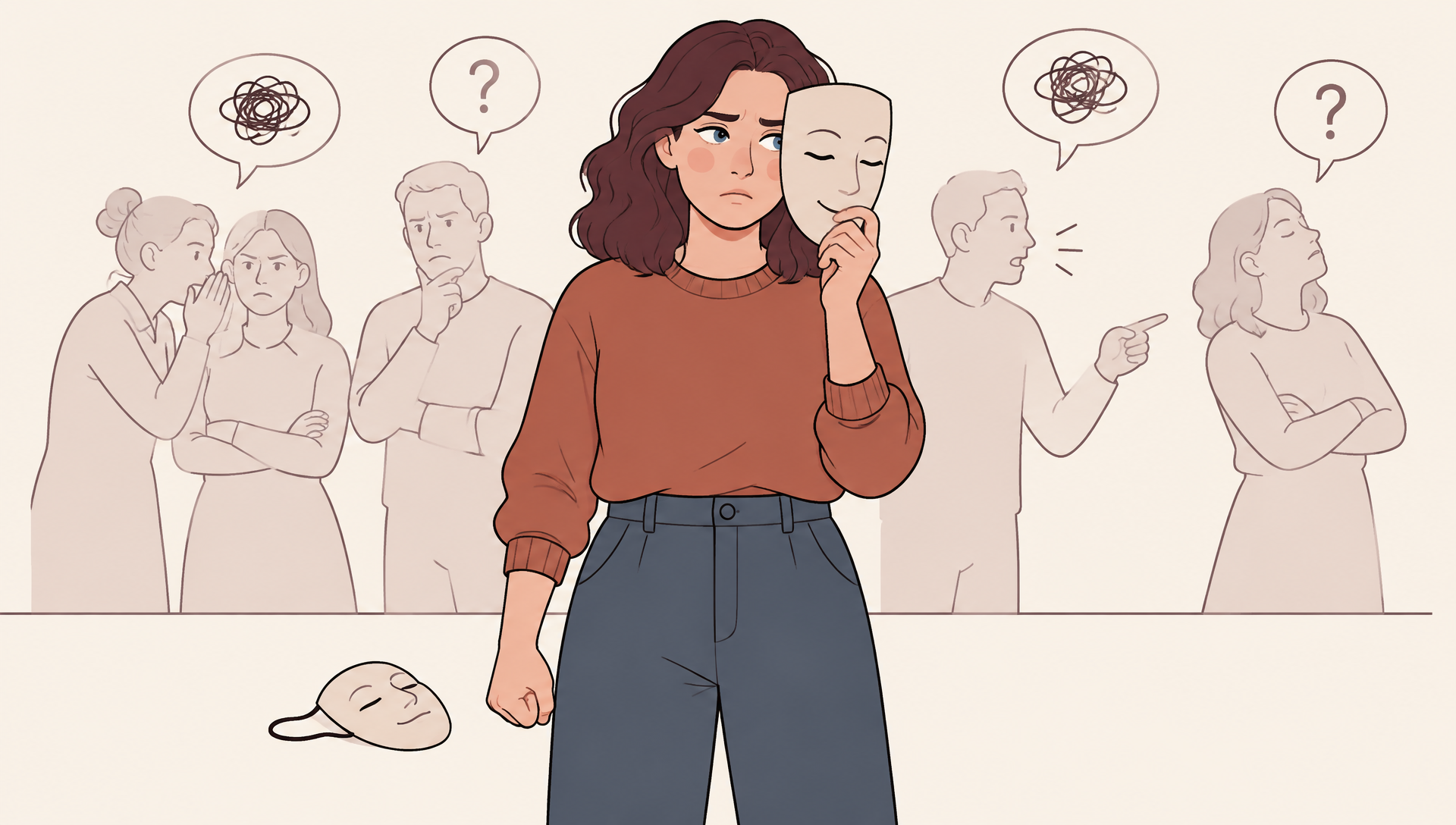
Chapter 01I was only just learning to take it off
When I was diagnosed, I didn't suddenly become a different person. I just started noticing how much effort I'd been putting into looking like one. The rehearsed conversations. The forced eye contact. The pretending I wasn't overwhelmed until I could get home, shut the door and fall apart somewhere more convenient for everybody else.
I'd spent years editing myself in real time. Don't interrupt. Don't move too much. Don't talk too loudly. Don't admit you've forgotten what somebody said while they're still saying it. Laugh when everyone else laughs, even if your brain was briefly in another postcode. Basically, produce and direct a convincing performance of Normal Woman while also trying to complete the actual conversation.
Diagnosis didn't fix that overnight. It did let me question it. I began saying when I was overloaded instead of making up an acceptable illness. I stopped forcing myself through things purely because other people seemed able to do them. I asked for instructions in writing. I let myself pause before answering. Tiny things, really, but each one felt like loosening a button on an outfit I'd been wearing since childhood.
Unmasking wasn't me giving myself permission to behave however I liked. It was me trying to work out which parts of my personality were actually mine and which were a customer service voice I'd accidentally left switched on for thirty-seven years.
Chapter 02Then everybody became an ADHD expert
Then ADHD became very visible. It was everywhere online. Some of that visibility was brilliant. Women heard experiences that sounded like theirs and finally had the words to ask for help. People who'd spent decades being called lazy, careless or too much found each other. That matters. Sometimes another person's honesty is the first crack of light you've had in years.
But visibility brought rubbish with it too. Bad videos reduced ADHD to a handful of vague habits. Influencers made claims that should've come with a medical degree but arrived with a ring light instead. A widely cited review of 100 popular ADHD TikToks found that clinicians judged 52 per cent of them misleading. The internet did what it always does: found a subject requiring nuance, flattened it into content and then acted surprised when nuance died.
The backlash didn't stay aimed at the bad information. It spread to everybody with ADHD. Suddenly, more people knowing the word meant the condition itself must be fashionable. More adults seeking assessment became proof that people were copying each other. Every inaccurate video became evidence for somebody who'd already decided we were making it up.
Now strangers who've read half a headline can explain my own diagnosis back to me. ADHD is apparently caused by phones, laziness, poor parenting, modern life or wanting special treatment. It can be cured by discipline, a walk, fewer screens and, presumably, being sent to a Victorian workhouse until morale improves.
We became visible enough to be noticed, but not believed enough to be safe.
Chapter 03The second mask
That's when the second mask starts to appear. The first one was built before I knew I had ADHD. The second is being built after diagnosis, with full awareness of exactly why I'm doing it.
I catch myself deciding whether it's worth mentioning ADHD at all. If I ask for something to be written down, will I sound reasonable or demanding? If I explain that I'm overwhelmed, will they understand or quietly add me to the imaginary list of women who've diagnosed themselves because they once lost their keys? If I make a mistake, will it be seen as a normal mistake or evidence that I've used my diagnosis as an excuse?
So I start translating myself again. I call sensory overload a headache. I call executive dysfunction being busy. I say I'm tired when what I mean is that I've held myself together so tightly all day that my body has started filing formal complaints.
The cruel part is that this mask looks like competence. People see you coping. They don't see the preparation, the panic, the recovery time or the furious internal monologue keeping every expression on your face workplace-appropriate. Then your apparent competence becomes proof that you can't really be struggling. Congratulations, your performance was so convincing that the audience has cancelled the condition.
Chapter 04Hyper-aware and completely exhausted
Once you're aware of masking, you can't become unaware of it. You hear yourself soften a request before you've made it. You notice your leg has stopped bouncing because somebody looked at it. You rewrite a message six times to remove any trace of need, emotion or being an actual human person.
At the same time, you're watching the wider conversation become nastier. One week ADHD is a cute internet trend. The next it's an epidemic of overdiagnosis. Then it's a social construct. Then it doesn't exist. We're somehow both absolutely everywhere and completely fictional, which is an impressive workload for a myth.
There isn't yet strong research proving that public attitudes have become worse since ADHD awareness grew online. I can't turn what I feel into a neat graph. But negative public attitudes aren't imaginary. A systematic review of community beliefs found familiar themes: that ADHD is overdiagnosed, that medication is unacceptable, that our difficulties are bad behaviour and that people would rather keep their distance.
Research specifically about ADHD masking is still developing, and much of the established camouflaging evidence comes from autism research. We should be honest about that. But studies of women diagnosed with ADHD later in life repeatedly describe criticism, shame, self-blame and years spent feeling fundamentally wrong. You don't need a laboratory to understand why somebody trained by criticism might start hiding again when the criticism gets louder.
Chapter 05Belief shouldn't be another assessment
Having a diagnosis should've ended the trial. Instead, it sometimes feels like I've just been moved to a different courtroom.
The waiting lists, assessments, forms and childhood evidence weren't enough. Now there's a second test, administered casually by colleagues, relatives, dates, doctors, television producers and Darren in the comments. Do I look ADHD enough? Am I struggling enough? Am I the right sort of diagnosed person? Have I suffered visibly, but not so visibly that it becomes inconvenient?
When a condition is constantly framed as a debate, disclosure becomes a gamble. At work, that gamble can affect whether somebody asks for reasonable adjustments they're entitled to. In healthcare, it can shape whether they feel able to describe what is happening honestly. In relationships, it can decide whether they ask for understanding or return to apologising for everything before anybody has even complained.
This isn't about demanding that nobody question bad information. They should. I question it too. Misinformation harms people with ADHD because it replaces a complicated disability with something shallow and easy to mock. But there is a huge difference between challenging a claim and treating a human being as the claim.
Chapter 06I'm not putting the whole thing back on
I'd love to say I'm refusing to mask ever again. That would be a satisfying ending. It would also be bollocks.
Masking can be protective. Sometimes the room isn't safe. Sometimes you need the job, the appointment or the relationship more than you need to educate another person. Nobody owes every part of themselves to an audience that has already decided not to listen. Choosing privacy isn't failure.
But I don't want disbelief to take everything back from me. I don't want to return to measuring every movement, rehearsing every sentence and treating my own needs like allegations requiring supporting evidence. I did that for long enough. It nearly broke me, and apparently the reward for doing it well was everybody assuming I was fine.
So maybe unmasking now looks less like a grand reveal and more like choosing where I can be honest. It's telling the truth to people who've earned it. It's asking for what I need without attaching a twelve-page defence. It's refusing to turn my life into a PowerPoint presentation every time somebody thinks ADHD has been invented by TikTok.
Awareness was supposed to make people like us easier to see. Instead, it has sometimes made us easier to inspect. But being inspected isn't the same as being known, and being doubted doesn't make us less real. I'm not a trend, a talking point or a symptom list somebody can swipe past. I'm a person who'd only just started breathing properly. I'm not giving all of that air back.
Sources and further reading
- The Canadian Journal of Psychiatry review of ADHD content on TikTok.
- Miss. Diagnosis, a systematic review of ADHD in adult women.
- Scientific Reports study of late-diagnosed women's experiences of ADHD.
- Journal of Attention Disorders systematic review of community attitudes towards ADHD.
- Autism Research study comparing camouflaging among autistic and ADHD adults.